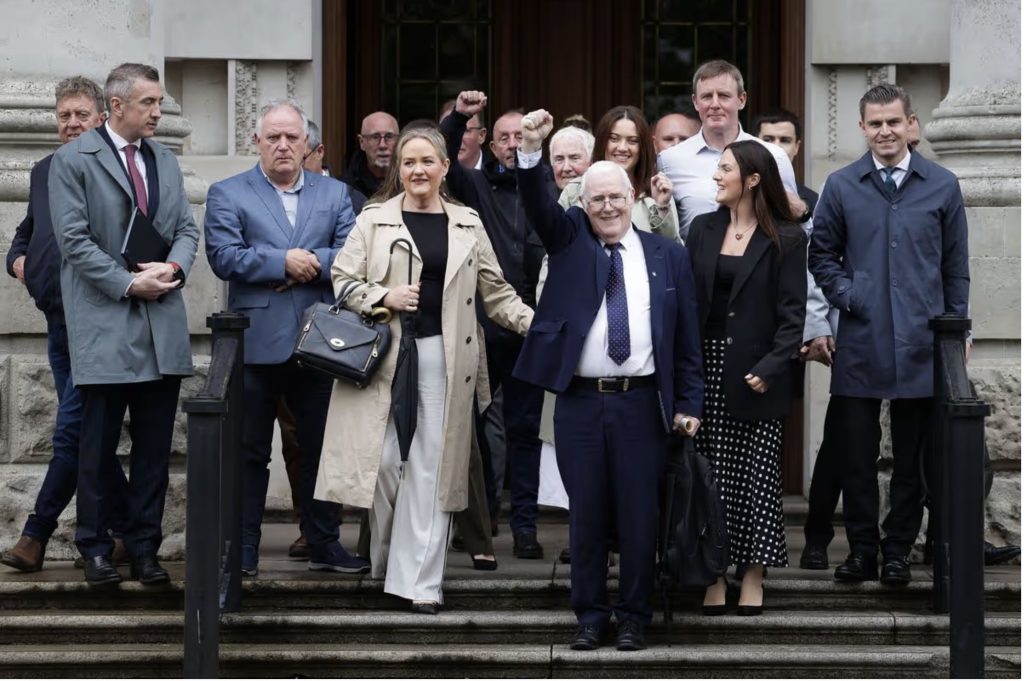
Phoenix Law has secured a settlement of £400,000 for the Reavey family, bringing to a close a decades-long pursuit of justice for state collusion in the murders of three brothers during the Troubles. The settlement represents one of the most significant civil collusion awards in recent Northern Ireland legal history.
Background: The Reavey Family and the Pursuit of Justice
On 4 January 1976, brothers John Martin, Brian, and Anthony Reavey were murdered at their family home in South Armagh in one of the most devastating atrocities of the Troubles. The murders were carried out by loyalist paramilitaries, but evidence gathered over subsequent decades pointed to a deeply troubling dimension: state collusion. Security force personnel (including RUC Officers and UDR Soldiers) facilitated, enabled, or failed to prevent the attack.
For the Reavey family, the pursuit of truth and accountability has spanned nearly fifty years. Despite the passage of time, the family supported by Phoenix Law’s specialist civil litigation team, refused to allow the State to escape responsibility. The case required painstaking investigative legal work, engagement with historic disclosure obligations, and sustained advocacy before the Courts.
The Legal Proceedings
Phoenix Law initiated civil proceedings on behalf of Eugene Reavey, pleading that state actors had materially contributed to the deaths through state collusion with paramilitaries. The proceedings engaged complex questions of state liability, disclosure of sensitive intelligence material, and the application of the Human Rights Act 1998 and Article 2 of the European Convention on Human Rights (the right to life).
The litigation drew on decades of historic findings, declassified documents, and witness evidence painstakingly assembled by Phoenix Law’s team. The family was represented throughout by solicitors who have established Phoenix Law as among the top solicitors in Belfast for sensitive state-accountability litigation.
The Settlement: What It Means
The £400,000 settlement was reached following a trial which was part heard before Mr Justice Kinney. The scale of the award, combined with the State’s decision to settle rather than contest the claim to trial, speaks clearly to the weight of the evidence assembled by the Phoenix Law team. The terms of the settlement include an apology in the following terms:
The Chief Constable acknowledges the generational grief and trauma that have been suffered by the Plaintiff and his family as a result of these murders.
The Chief Constable apologies to the Plaintiff for the inadequacies in the investigation of these murders and acknowledges that these failures have caused additional distress to the Plaintiff and his family.
The Chief Constable acknowledges and accepts the statements made to Mr Reavey in 2006 when he received an apology by the then head of the Historical Enquiries Team (“HET”), for the harassment he described being subjected to in the aftermath of the murders.
The Chief Constable accepts without reservation that the Plaintiff had no involvement whatsoever in any paramilitary or terrorist activity.
The Chief Constable accepts without reservation that the three Reavey brothers who were murdered had no involvement whatsoever in any paramilitary or terrorist activity.
The Chief Constable acknowledges and accepts that the behaviour and failures of members of the RUC may have contributed to the murders of John Martin Reavey, Brian Reavey and Anthony Reavey and to the loss suffered by the Plaintiff and his family. The Chief Constable apologises unreservedly for any such behaviour and failures and for the enduring consequences that have flowed from them.
For the Reavey family, this decision is a form of vindication: a formal recognition that the State’s conduct fell beneath the standard required by law, and that the suffering inflicted upon the family extended far beyond the night of 4 January 1976. It is also a reminder that no lapse of time, and no institutional resistance can permanently deny justice to families prepared to pursue it.
Significance for State Collusion Cases in Northern Ireland
Cases of this nature are among the most legally and emotionally complex that any litigation team can undertake. They require expertise in public law, human rights law, disclosure obligations, and the evidential challenges posed by historic intelligence material, precisely the areas in which Phoenix Law has built its reputation as top solicitors in Belfast.
The outcome also has broader implications for the ongoing question of legacy and truth recovery in Northern Ireland. At a time when legislative changes threaten to curtail civil proceedings connected to the Troubles, the Reavey settlement demonstrates the continuing importance of civil litigation as a route to accountability.
Phoenix Law’s Expertise in State Accountability and Civil Litigation
Phoenix Law is consistently recognised among the top solicitors in Belfast for complex civil litigation, human rights, and state-accountability work. Our team has represented families, survivors, and communities across a wide range of historically sensitive cases, achieving outcomes that reflect both our legal expertise and our commitment to justice for those who have been let down by institutions of the State.
If you or your family have been affected by state collusion, unlawful killing, or any related matter arising from the Troubles, our team is available for confidential consultation. We have the experience, the resources, and the determination to take on the most challenging cases — and to see them through.
Recent Posts
-
Home Office Concedes Urgent High Court Challenge to Continued Immigration Detention
-
 Summerland Families to Appeal Deemster’s Ruling
 -
 Supreme Court rejects ex-Councillor’s Appeal against Drag Queen Story Time Judgment
 -
 Mother and Baby Homes – Independent Panel Report
 -
 A Commission of Investigation Into Michael Shine: What the Scoping Report Means